
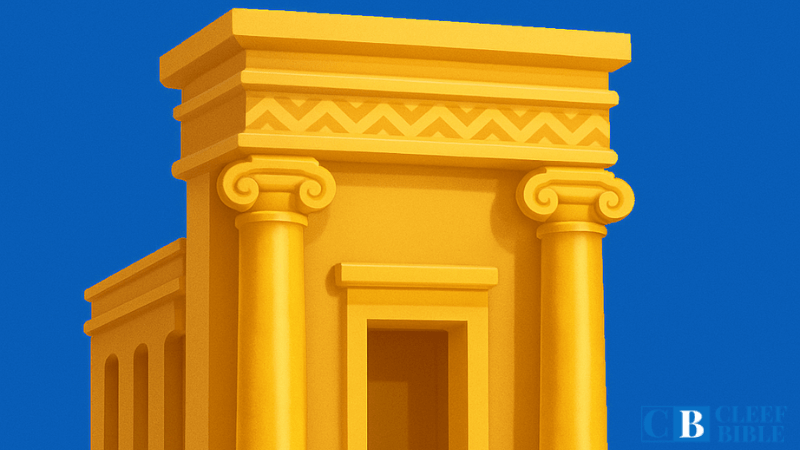
Could a structure made by human hands contain the glory of the eternal God?
That is the question that arises when contemplating Solomon's Temple, one of the most enigmatic, revered, and debated constructions in all of biblical history.
More than a majestic building, it was the spiritual heart of Israel, a symbol of the divine covenant and a center of universal worship.
From its lavish dedication to its dramatic destruction, the temple has influenced not only theology and faith, but also the architecture, politics, and culture of entire civilizations.
In this article, we will explore its origin, meaning, structure, functions, impact on biblical prophecy, and its presence in modern debate.
What made Solomon's Temple so special? And why does it continue to inspire such fascination today? The answer may surprise you.
What is Solomon's Temple and why is it so important?
He Solomon's Temple It was the first temple built in Jerusalem to worship the God of Israel. Erected by King Solomon around 960 BC, it represented the fulfillment of his father David's dream: a stable place where the name of the Lord would dwell (1 Kings 8:20). This temple was not just a monumental building, but the spiritual, religious and cultural center of the people of Israel for centuries.
Its importance lies in the fact that it was the place where sacrifices were made, solemn feasts were celebrated and where the Ark of the Covenant resided in the Holy of Holies. Since its dedication, the Temple was seen as the heart of the covenant between God and Israel, and its destruction represented one of the greatest tragedies in the history of the Jewish people.
The temple as a symbol of God's presence
More than a physical structure, Solomon's Temple was the tangible symbol of God's presence among his peopleOn the day of its dedication, the glory of the Lord is recorded as having filled the temple like a cloud (1 Kings 8:10–11), which manifested divine approval and closeness.
For the Israelites, the temple was a spiritual guarantee: the place where the sky touched the earth, where atonement for sin was offered, and from where God heard prayers. The temple became the center of worship, forgiveness and communion with God, giving meaning to the spiritual identity of the people.
Its relevance in Judaism, Christianity and universal culture
In it JudaismSolomon's Temple was the centerpiece of worship, and its destruction marked a turning point, paving the way for the development of Rabbinic Judaism. Many Jews still pray facing Jerusalem, hoping that the temple will one day be rebuilt.
In it Christianity, the temple takes on a deeper meaning: Jesus presents himself as the true Temple, where the fullness of God dwells (John 2:19–21). Christians see in it the fulfillment of the temple promises, and in the church the new spiritual temple formed by believers.
In the universal cultureSolomon's Temple has been a source of inspiration in art, architecture, literature, Masonic symbolism, and esoteric thought. Its image endures as one of humanity's great sacred monuments, and its history continues to spark fascination, debate, and a search for meaning to this day.
Historical background and preparation
David's desire to build a temple
The initial impetus to build the temple came from King David, who, observing that he lived in a house of cedar while the ark of God remained in a tent, expressed his desire to build a permanent place for the Lord (2 Samuel 7:1–2). His intention was not only practical, but deeply spiritual: he wanted to honor God with a sanctuary worthy of His presence.
However, although his motivation was sincere, God did not allow him to build the temple, because David had been man of war and shedder of blood (1 Chronicles 28:3) Still, God honored his wish and included him in the plan: It would be his son who would build the temple.
The divine refusal and the promise to Solomon
God, through the prophet Nathan, communicated to David that his son would be the builder of the templeThis promise was accompanied by a covenant:
“He will build a house for my name, and I will establish the throne of his kingdom forever.” (2 Samuel 7:13).
This Davidic covenant not only ensured the construction of the temple, but also the continuity of the Davidic dynasty, which would later have messianic implications. Solomon, his son, was chosen as the heir to the throne and the sacred project.
Material gathering and architectural planning
Although he was not allowed to build, David took charge of gather materials in abundance for the temple: gold, silver, bronze, cedar wood, precious stones, and detailed plans given by divine inspiration (1 Chronicles 22 and 28). He also organized the Levites, artisans, and musicians who would serve in the future sanctuary.
Solomon inherited meticulous planning and abundant resources, which facilitated subsequent construction. The preparation was so thorough that it allowed the temple to be built in just seven years (1 Kings 6:38), which was extraordinary for a project of such magnitude.
Cultural influences on temple design
The design of Solomon's Temple did not emerge in an architectural vacuum. Although the model was based on the instructions for the tabernacle of Moses, incorporated artistic and structural elements common in the ancient world.
Among the most notable influences are:
- Phoenician architecture, thanks to the alliance with Hiram, king of Tyre, who provided cedar wood and highly skilled workers.
- Canaanite Templar models, where the use of monumental columns and stepped sacred spaces was common.
- Mesopotamian symbolism, such as the use of cherub figures and floral decorations that represented Eden.
Despite these external influences, the temple maintained its unique character as an exclusive place for the God of Israel, distinguished by its monotheism, its radical holiness, and its theologically charged design. It was a construction culturally contextual but spiritually revealed.
Construction of Solomon's Temple
Time of building and supervision of Solomon
The construction of Solomon's Temple began in the fourth year of Solomon's reign, around year 966 BC, and took seven years to complete (1 Kings 6:1,38) Solomon personally directed the project, demonstrating great administrative and spiritual wisdom.
During the proceedings, no sound of hammers or iron tools was heard inside the temple itself (1 Kings 6:7), indicating a meticulous prior preparation and an atmosphere of reverence. Everything was assembled with precision, as an expression of holiness and divine order.
The role of King Hiram of Tyre and his artisans
Solomon requested the help of the King Hiram of Tyre, an ally of his father David, who sent high-quality materials and expert craftsmen, especially a master named Hiram-Abi, skilled in metal, stone, wood, and artistic design (2 Chronicles 2:13–14).
- Cedar and cypress wood It was brought from Lebanon.
- Phoenician artisans They built ornamental pieces and columns.
- The alliance with Tyre symbolized an international collaboration for the glory of the God of Israel.
This cooperation reflected how, even in ancient times, God used foreign nations to fulfill their redemptive purposes.
Precious workmanship, dimensions and materials
The work involved tens of thousands of workers:
- 30,000 men to cut wood,
- 70,000 chargers,
- 80,000 stonemasons,
- 3,600 supervisors (2 Chronicles 2:17–18).
The temple was approximately 27 meters long, 9 meters wide and 13.5 meters high (1 Kings 6:2), but its beauty lay more in its symbolism and ornamentation than in its size.
The materials were extraordinary:
- Pure gold covered the interior of the Most Holy Place.
- Carved stones, bronze, silver, cedar wood and sculpted pomegranates adorned every corner.
- All the furniture was made according to the divine model delivered.
The result was a unprecedented sanctuary, where Beauty, art and holiness came together to reflect the glory of God.
Relationship between temple, covenant and obedience
The construction of the temple was not only an architectural act, but a visible renewal of the covenant between God and Israel. In 1 Kings 6:12–13, God told Solomon:
“If you walk in my statutes… I will dwell among the children of Israel and will not forsake my people.”
This shows that the permanence of the divine presence did not depend solely on the building, but on the obedience of the people to the commandments of GodThe temple was a symbol of the covenant, but fidelity was the true foundation.
Therefore, the temple could be destroyed, as it later was, if the people abandoned the law. The message was clear: God dwells where there is holiness, not just where there is splendor.
Structure and layout of the temple
The atrium, the Holy Place and the Most Holy Place
Solomon's Temple was divided into three main sacred spaces, which marked a progression from the common to the completely holy:
- The outer atrium: This was the area accessible to the priests and the Israelites. Sacrifices were made there on the bronze altar, and the Molten Sea was used for ritual purification.
- The Holy Place: A space reserved exclusively for the priests. It contained key elements such as the table of shewbread, the altar of incense, and the candlesticks.
- The Holy of Holies (Debir): This was the spiritual center of the temple, which only the high priest could enter once a year on the Day of Atonement. The Ark of the Covenant rested there.
This structure reflected progressive holiness and restricted access to the divine presence, pointing to the need for mediation, purity and atonement.
Columns Jachin and Boaz
In front of the temple, in the portico, stood two monumental bronze columns (1 Kings 7:15–22):
- Jaquin (“He will establish”)
- Boaz (“In Him there is strength”)
These columns did not support the building, but had a purpose. symbolic and theological. They represented:
- The stability and faithfulness of God's covenant
- Divine strength as the basis of the kingdom
Decorated with capitals of lilies and pomegranates, they also symbolized life, beauty and spiritual fertility. They were a visual reminder that God's house was built on eternal promises.
The Bronze Altar and the Molten Sea
Inside the atrium were two fundamental elements for the ritual:
- The bronze altar: A place where animal sacrifices were offered as sin offerings, burnt offerings, and peace offerings. It symbolized the need for atonement to approach God.
- The Sea of Casting: A huge bronze vessel supported by twelve oxen (1 Kings 7:23–26), capable of holding thousands of liters of water. It was used for the ritual ablutions of the priests.
Both elements reflect the principle that Access to God requires cleansing and replacement, teachings that would later find their fulfillment in the sacrifice of Christ.
Interior furnishings: incense altar, table, candlesticks
Inside the Holy Place were carefully arranged elements:
- The altar of incense: located just before the veil that separated the Holy Place from the Most Holy. The incense symbolized the prayers of the people that rose before God.
- The Table of Shewbread: contained twelve loaves that represented The twelve tribes of Israel and God's constant provision.
- The candelabras (menorah): seven arms with continuous fire, represented divine light, the presence of the Spirit of God and the spiritual life of the people.
All the furniture was gold-plated and made with specific design, reflecting the beauty, purity and glory of the worship of the living God.
The Ark of the Covenant in the Most Holy Place
At the heart of the temple, within the Holy of Holies, was the most sacred object: the Ark of the CovenantThis gold-plated wooden box contained:
- The tablets of the Law
- The Aaron's rod that budded
- A glass with manna (according to Hebrews 9:4)
On the ark were two golden cherubs, whose wings covered the propitiatory, the lid of the ark where the blood was sprinkled on the Day of Atonement.
The Ark symbolized the presence of God, his covenant, his throne and his mercyIt was the place where God manifested himself uniquely to his people. When the temple was dedicated, the cloud of God's glory filled it, sealing his presence there.
Thus, the entire temple pointed to a central message: the holiness of God, the need for redemption, and the longing for eternal communion between the Creator and his people.
Dedication of the temple
Solomon's Solemn Prayer (1 Kings 8)
Once the construction was completed, Solomon gathered all of Israel to dedicate the temple with a long, solemn and deeply theological prayer (1 Kings 8:22–53). In it:
- He recognized the greatness and faithfulness of God in fulfilling his promise to David.
- He declared that not even the heavens can contain God, much less a house made by human hands.
- He prayed that God would hear the prayers raised from that place, both in times of blessing and in times of need, sin, war or captivity.
- He interceded for the forgiveness, restoration, and repentance of the people.
Solomon's Prayer did not focus on the building, but in the God who would dwell there and in the living relationship between Him and His people.
The glory of God filling the sanctuary
After the prayer, something supernatural and deeply shocking happened:
“When Solomon had finished praying… the glory of the Lord filled the house of the Lord.” (2 Chronicles 7:1–3)
- A fire came down from heaven and consumed the sacrifices on the altar.
- A glorious cloud filled the temple, to the point that the priests could not continue ministering.
This demonstration confirmed that God accepted the built house and responded with his presence. In biblical theology, the glory of God represents his visible, majestic, holy and active essence, living in the midst of the people.
Sacrifices, festivals and divine presence
The dedication was not only spiritual, but also a national celebration unprecedented:
- They offered 22,000 oxen and 120,000 sheep in sacrifice (1 Kings 8:63).
- The town celebrated a great festival during seven days, followed by another seven-day festival.
- The divine presence became a reason for joy, reverence and collective communion.
This event marked the temple as the new center of Israel's religious, political, and cultural life, and as a place from which God's blessing would flow to future generations.
The temple as a house of prayer for all nations
Although built by and for Israel, Solomon expressed a surprising desire in his prayer:
“The stranger also… will come and pray toward this house. You will hear from heaven… and do according to all that the stranger cries to you.” (1 Kings 8:41–43)
This fragment reveals the missionary dimension of the temple: It was not a symbol of exclusion, but a place of access to God for all who sincerely seek himJesus himself would reaffirm this principle centuries later, saying:
“My house will be called a house of prayer for all nations.” (Mark 11:17).
Solomon's temple, although geographically located, was conceived as a universal spiritual beacon, anticipating the plan of redemption that would reach the whole world through the Messiah.
Spiritual and religious function of the temple
Center of sacrifice and atonement
Solomon's Temple functioned as the epicenter of the sacrificial system of the Old Testament. Daily and special sacrifices were offered there for three essential purposes:
- Atonement for sin: Through animal sacrifices, the people sought divine forgiveness.
- Thanksgiving and consecration: through voluntary offerings, vows and burnt offerings.
- Communion with God: through peace offerings, which were shared between the worshipper and the priests.
These rituals were not magical or empty: they represented a spiritual pedagogy to remind the people of the gravity of sin, the need for a mediator, and the grace of divine forgiveness. The temple altar was a place of blood and redemption, prophetically pointing to Christ as the perfect sacrifice.
Place of pilgrimage and festivities
Three times a year, the Israelites were to appear before God in Jerusalem to celebrate the great feasts (Exodus 23:14–17):
- Passover: remembered the liberation from Egypt.
- Pentecost (Weeks): celebrated the giving of the law and the harvest.
- Tabernacles: commemorated God's provision in the desert.
These pilgrimages turned the temple into a center of national unity and spiritual communion, where thousands of people gathered in worship and gratitude. Prayers, psalm singing, and family and community gatherings were also held.
The temple was more than a building: It was a meeting point between God and his people.
Representation of heaven on earth
The design of the temple reflected a symbolic structure that imitated heaven itself:
- The Holy of Holies represented the throne of God.
- The cherubs, palm trees and carved flowers symbolized the Garden of Eden and the ordered cosmos.
- The number seven (candlesticks, steps, measures) expressed divine perfection.
Thus, the temple was a miniature of the theological and spiritual universe, a place where heaven descended to earth and man could meet his Creator.
It was, in essence, the point of intersection between the divine and the human.
The Temple and Israel's National Identity
Beyond its religious function, the temple was the ultimate symbol of national identity of the people of Israel. It represented:
- The divine choice of Israel as a covenant people.
- The centrality of Jerusalem as a holy city.
- The spiritual sovereignty of God as king over his nation.
When the temple was destroyed by Nebuchadnezzar in 586 BC, it was not just an architectural loss: It was a national, theological and emotional crisisIts reconstruction in the time of Zerubbabel and its subsequent renovation by Herod the Great reflect the deep desire of the people to restore their connection with God and their identity as a sacred nation.
In short, the temple not only organized spiritual life, but shaped the history, hope, and purpose of the people of Israel.
Decline, destruction and consequences
Idolatry and corruption in later times
After Solomon's death, the kingdom was divided, and eventually even Judah—the southern kingdom where the temple was— He immersed himself in idolatry, social injustice and religious corruptionKings such as Manasseh and Amon allowed the worship of idols within the temple itself (2 Kings 21), desecrating the holy place with pagan practices.
The priests became indifferent, the sacrifices lost their meaning, and the temple went from being house of prayer a place of empty routine. The hearts of the people turned away from God, which turned the temple into a structure without divine presence.
Prophecies of judgment for abandonment of the law
Prophets like Isaiah, Jeremiah, Micah and Ezekiel They warned that the destruction of the temple would be imminent if the people did not repent. Jeremiah was even accused of treason for prophesying that Jerusalem would be razed:
“What do you trust in, that you come to this temple… and say, ‘Temple of the Lord, temple of the Lord’? If you do not amend your ways…” (Jeremiah 7:3–4)
The judgment was not capricious: it was the result of the persistent breach of the covenant, and the temple would be destroyed as a sign that the relationship with God had been fractured.
Destruction by Nebuchadnezzar in 586 BC
Finally, in the year 586 BC, the Babylonian army commanded by Nebuchadnezzar completely destroyed Jerusalem and its templeThe account in 2 Kings 25 and Jeremiah 52 tells how:
- The temple was looted and burned.
- The sacred utensils were taken to Babylon.
- The people were killed or taken into exile.
The loss of the temple broke the religious, political and spiritual life of Judah, and marked the end of the monarchical period. The ultimate symbol of God's presence was reduced to ruins, thus fulfilling the prophetic warnings.
Exile of Judah and loss of the temple
The exile in Babylon was a stage of deep humiliation, lament and spiritual reflectionWithout a temple, sacrifices, or land, the people were forced to rediscover their faith:
- It was strengthened reading of the law and the prophets.
- The following arose: synagogues as places of teaching.
- The value was higher obedience than external ritualism.
Although painful, the exile prepared the people for a spiritual rebirth and for a deeper vision of the relationship with God, no longer based solely on a physical place.
The Second Temple and its differences with Solomon's
Reconstruction under Zerubbabel
Following Cyrus' decree in 538 BC, a group of Jews returned to Jerusalem and, under the leadership of Zerubbabel and Joshua, began the reconstruction of the temple (Ezra 1–6). This second temple It was completed in 516 BC, although with less splendor than the original.
The elders who remembered the first temple They cried when they saw the new one, since it did not have:
- The Ark of the Covenant
- The visible glory of God
- Many golden ornaments from Solomon's temple
However, the prophets Haggai and Zechariah encouraged the people, stating that “The latter glory of this house will be greater than the former” (Haggai 2:9), pointing to future fulfillment in Christ.
Herod the Great's Renovations
In the 1st century BC, King Herod undertook an ambitious renovation of the second temple, seeking to impress Rome and gain favor with the Jews. This project lasted decades and turned the temple into a impressive complex, with monumental walls and enlarged courtyards.
Although spectacular in architectural terms, her spiritual purity was questioned by many, including Jesus, who called it a “den of thieves” (Matthew 21:13).
Structural and spiritual comparisons
Solomon's Temple:
- Built by divine inspiration.
- Consecrated with the visible presence of God.
- Built with luxury materials.
The Second Temple (Zerubbabel–Herod):
- Rebuilt with human effort after the exile.
- Without the Ark, nor visible glory.
- More political and ritualistic in the NT context.
Spiritually, the first represented the inauguration of the pact with the United Kingdom, and the second, the hope of the Messiah in the midst of national suffering.
Final destruction in 70 AD by the Romans
In the year 70 AD, in response to a Jewish revolt, The Roman general Titus razed Jerusalem and destroyed the temple completely, fulfilling the prophecies of Jesus (Luke 21:6).
With its destruction:
- The sacrifices ceased until today.
- The start was made Jewish diaspora.
- The focus of the Jewish faith shifted towards Torah and the synagogue.
For Christians, the destruction of the temple confirmed that Christ's sacrifice had fulfilled what the temple represented, and that true worship no longer depended on a physical place, but on the Spirit and truth (John 4:21–24).
Solomon's Temple in Biblical Prophecy
Typology of the temple in the New Testament
In the New Testament, Solomon's Temple is understood not only as a physical building, but as a prophetic shadow of greater spiritual realitiesIts structure, functions, and symbolism pointed to future fulfillment in Christ:
- He Holy of Holies It represented the divine dwelling place inaccessible without mediation.
- The daily sacrifices anticipated the unique sacrifice of Jesus.
- He veil that separated The holy place of the Most Holy prefigured the separation between God and man because of sin.
Hebrews 9 and 10 explain that the earthly temple was a figure of the true heavenly temple, where Christ entered with his own blood as the eternal High Priest.
Jesus as the fulfillment of the temple
Jesus said something radical:
“Destroy this temple, and in three days I will raise it up.” (John 2:19).
Juan clarifies that he was talking about his own body as a temple.
This means that Jesus is:
- The presence of God among us (Emmanuel)
- The perfect sacrifice for sin
- The new meeting place between God and man
After his resurrection, a physical temple is no longer needed to worship, because Jesus himself is the true temple, the fulfillment of all the shadows of the Old Testament.
Third temple in recent times?
Some interpreters of biblical prophecies believe that a literal third temple in Jerusalem, based on passages such as:
- Ezekiel 40–48 (vision of the future temple)
- 2 Thessalonians 2:4 (the man of sin in the temple)
- Revelation 11:1–2 (measuring the temple)
This topic is highly debated among scholars and believers. Some see these passages as symbolic and spiritually fulfilled in the church or in Christ, while others wait a literal reconstruction of the temple as part of the events of the end.
The Church as a Temple of the Holy Spirit
A clear and universal teaching in the New Testament is that The church is now the spiritual temple of God:
- “Do you not know that you are the temple of God and that the Spirit of God dwells in you?” (1 Corinthians 3:16)
- “You also are being built up… for a dwelling place for God through the Spirit” (Ephesians 2:22)
This means that:
- Every believer is a “living temple.”
- The Christian community represents the place where God dwells.
- Holiness, unity, and mutual love are now the “spiritual architecture” of the new temple.
Archaeology and current debates
Where exactly was the original temple?
The most accepted location is the Temple Mount in Jerusalem, a rectangular esplanade in the Old City. However, some researchers have proposed:
- He Mount Zion as a possible location.
- Areas adjacent to the current esplanade, under Muslim constructions.
The lack of in-depth excavations in the area —for political and religious reasons— limits direct archaeological confirmation.
The Temple Mount and the Wailing Wall
He Temple Mount It is the most disputed site in Jerusalem:
- There are currently the Dome of the Rock and the Al-Aqsa Mosque, which complicates any attempt at reconstruction.
- He Wailing Wall is considered the closest remnant to the original temple, and has been a place of prayer for Jews for centuries.
The sanctity of this site for Jews, Muslims and Christians makes it a point of permanent international tension.
Related archaeological discoveries
Although the temple itself has not been found, elements have been found that support its existence:
- Remains of walls, steps and tunnels near the Temple Mount.
- Inscriptions that refer to the temple or Jerusalem as a religious center.
- Ritual utensils and seals from biblical times.
These findings confirm that Jerusalem was an important religious center and support the biblical account from a historical and archaeological perspective.
Solomon's Temple and modern political conflict
The idea of rebuilding the temple is closely linked to the Israeli-Palestinian conflictFor many Orthodox Jews, the return of the Messiah will be accompanied by a reconstruction of the temple. However:
- Any attempt to build on the Temple Mount would trigger an international crisis.
- Activist groups have created models, plans, and sacred utensils ready for the supposed “third temple.”
For some Christians, this conflict is part of the prophetic fulfillment, while for others, the emphasis should be on the spiritual temple in Christ, not in material structures.
Solomon's Temple, centuries after its destruction, It remains a living theme that unites faith, history, politics and eschatology.
Cultural and symbolic representations
Influence on art, literature and architecture
Solomon's Temple has been an inexhaustible source of artistic inspiration throughout the centuries. the painting, is represented with solemnity and splendor, as a symbol of the divine presence on earth. In the religious and secular literature, it is described as a place of mystery, power and wisdom.
In the world of sacred architecture, many churches, cathedrals and synagogues have adopted elements of temple design:
- The use of symbolic columns (inspired by Jachin and Boaz)
- The layout in three sections (narthex, nave and altar)
- Decorations based on the stories of sacred furniture
The temple remains a structural and spiritual reference in many spaces dedicated to worship.
Masonic interpretations of the temple
In the tradition of the masonry, Solomon's Temple has a central place as a symbol of wisdom, enlightenment and spiritual construction. It is interpreted allegorically as:
- The process of building human character
- The search for divine knowledge
- The balance between body, soul and spirit
Biblical characters such as Hiram Abí become symbolic figures within the Masonic ritual languageAlthough these interpretations are not theological, they show how The temple has been adopted by philosophical and esoteric traditions for educational and symbolic purposes.
The temple as a spiritual archetype in various traditions
Beyond Judaism and Christianity, the Temple of Solomon has been considered in other religious and mystical currents as a archetype of the inner temple:
- In the Jewish Kabbalah, the temple reflects the structure of the universe and the human soul.
- In it mystical Christianity, represents the dwelling of the Holy Spirit in the heart of the believer.
- In certain visions philosophical and esoteric, is a symbol of cosmic order, balance and spiritual ascension.
The temple is not just a past structure: it is a living idea that represents the connection between the divine and the human.
References in films, novels and historical debates
Solomon's Temple has also been portrayed in the popular culture as a place of mystery, hidden power or transcendent revelation:
- In movies like Indiana Jones either National Treasure, appears as an object of archaeological and mystical research.
- In novels like The Da Vinci Code, is related to ancient secrets and hidden lineages.
- In documentaries and conspiracy theories, it is presented as the axis of eschatological conflicts.
These references, although often speculative, keep the historical and spiritual fascination alive through the temple, and show how his figure continues to provoke debates, inspirations and searches for meaning in the 21st century.
Book recommendations about Solomon's Temple
📘 “Solomon’s Temple: Myth and Reality” – William J. Hamblin and David Rolph Seely
A rigorous work that examines the biblical, archaeological, and cultural sources of the temple. It provides historical clarity and debunks common myths.
📘 “Temples in the Biblical World” – Victor Hurowitz
A comparative analysis of Solomon's Temple and other temples of the ancient Middle East. Ideal for theological and archaeological studies.
📘 “Jerusalem in the Time of Solomon” – Israel Finkelstein
From a critical archaeology perspective, this book raises questions about the historicity of the temple and its real context. Provocative and scholarly.
Frequently Asked Questions about Solomon's Temple
Where is Solomon's Temple mentioned in the Bible?
Solomon's Temple is described mainly in 1 Kings 5–8 and 2 Chronicles 2–7, which narrates its construction, dedication, and design. It is also mentioned in the prophetic books and some Psalms as a symbol of the divine presence in Jerusalem.
Why couldn't David build the temple?
God did not allow David to build the temple because had shed a lot of blood in wars (1 Chronicles 28:3) Instead, he promised that his son Solomon, a king of peace, would be the one to build it as part of an everlasting covenant.
What function did the Ark of the Covenant have within the temple?
The Ark of the Covenant was in the Holy of Holies and represented the very presence of God among his peopleIt contained the tablets of the Law and was covered by the mercy seat, where the rite of atonement was performed on the Day of Atonement. It was the spiritual heart of the temple.
What was the difference between the Holy Place and the Most Holy Place?
- The Holy Place It was where only the priests could enter daily to perform rites with the altar of incense, the table of bread and the candlesticks.
- The Holy of Holies, on the other hand, was the most sacred place, to which Only the high priest could enter once a year, to sprinkle the blood of atonement before the Ark of the Covenant.
What did the elements of the temple symbolize?
Each part of the temple had a symbolic burden:
- The altar: redemption.
- The candelabra: divine light.
- The veil: separation by sin.
- The Ark: God's presence and covenant.
- The columns: divine strength and stability.
The whole temple pointed to the holiness, communion and redemption offered by God.
Can Solomon's Temple be rebuilt today?
Technically it is possible, but The Temple Mount is occupied by the Dome of the Rock and the Al-Aqsa Mosque, which makes any attempt at reconstruction a source of international religious and political crisis. Some Orthodox Jewish groups yearn for its reconstruction as part of the Messianic era.
What prophecies relate to the temple?
There are several:
- Ezekiel 40–48 describes a future temple.
- Haggai 2:9 promises greater glory for the second house.
- In 2 Thessalonians 2:4 and Revelation 11, scenarios are mentioned where a temple appears in recent times.
Many Christians interpret these prophecies as spiritually fulfilled in Christ or the Church, while others expect literal fulfillment.
Was Jesus a figure who replaced the temple?
Yes. In John 2:19–21, Jesus identified himself as the new temple, the place where God's presence dwells. His sacrifice on the cross was the perfect atonement, and his resurrection marks the beginning of a new pattern of worship “in spirit and in truth” (John 4:24).
What remains of Solomon's Temple today?
Currently only a part of its external structure remains, known as the Wailing Wall. Although not a direct part of the original temple, it is considered the closest thing to its location. Today it is a place of prayer and mourning for the Jewish people.
How does your concept influence Christian theology?
The temple teaches about:
- The holiness of God
- The need for redemption
- The role of spiritual mediation
For Christians, the temple prefigures Christ and the Church as a spiritual temple. It also teaches that true worship It does not depend on a place, but on a living relationship with God through Jesus.
Conclusion
Solomon's Temple was much more than an impressive architectural work; it was the epicenter of faith, identity, and hope for an entire people.
Its construction marked a milestone in Israel's spiritual history, and its destruction left an indelible mark on the collective memory.
But his legacy did not lie in ruins: his symbols, teachings, and prophecies live on in the Gospel message, where Christ is presented as the true temple, the divine presence made flesh, and the definitive place of encounter with God.
Today, every believer is called to be part of that living temple, reflecting holiness, obedience, and authentic worship.
What does Solomon's Temple represent to you in your faith or spiritual understanding?
Leave us your comment and share your thoughts with the community.
Discover How the Bible Can Transform Your Life
- Bible Study – explore the teachings of the Bible and find answers to life’s challenges.
- Fundamental Beliefs – delves into the principles that have guided millions through the centuries.
- Spiritual Growth – Strengthen your faith with studies designed to bring you closer to God.

Discover How the Bible Can Transform Your Life
- Bible Study – explore the teachings of the Bible and find answers to life’s challenges.
- Fundamental Beliefs – delves into the principles that have guided millions through the centuries.
- Spiritual Growth – Strengthen your faith with studies designed to bring you closer to God.

Would you like to save this content?
Download this article as a eBook PDF professional.
📥 DOWNLOAD EBOOK NOW









 English
  Spanish
  French
0 Comments