Is it possible to have great gifts, a lot of potential… and still destroy your own life from within?
That question goes straight to the heart of Samson's story in the Bible. Many remember Samson only as the man of supernatural strength and long hair, but his life reveals something much deeper: the struggle between God's calling and human weaknesses.
Samson was chosen before birth, set apart for a special mission, and endowed with extraordinary power. However, behind his visible victories lay impulsiveness, emotional decisions, and an internal struggle that ultimately shaped his destiny.
That's why his story remains so relevant. Today, too, there are talented, capable people destined for great things, but held back by pride, emotional turmoil, harmful relationships, or a neglected faith. In that sense, Samson is not just an ancient figure: he is a mirror for our generation.
In this article you will discover the true spiritual meaning of Samson, his mistakes, his strengths, and the practical lessons that can help you live with more character, wisdom, and dependence on God in today's world.
Because perhaps the greatest enemy is not always outside… many times it is within us.
To truly understand Samson in the Bible, We need to step away for a moment from the image of the strong man and look at the world in which he lived.
Samson belongs to the time of the judges of Israel, This was a period when the people were already in the Promised Land, but still had no king. There was no central authority to organize political, military, and spiritual life.
The Bible describes that time with a simple yet stark phrase: everyone did what was right in their own eyes. There were constant cycles of disobedience, oppression, outcry, and deliverance through a judge.
The mission of judges in Israel
A judge He wasn't just someone who resolved legal conflicts. He had at least three key roles that help you understand Samson's life:
- Military leader, who guided the people in their defense against external enemies.
- Spiritual guide, which called on Israel to abandon idolatry and return to God.
- Unit figure, which encouraged the tribes to act together and not in isolation.
Samson, from birth, was set apart by God for this task. However, unlike other judges, his struggle appears more individual, almost solitary, marked by personal conflicts with the Philistines.

Who were the Philistines and why do they matter in the story of Samson?
The Philistines They were a powerful people, with a developed military and cultural presence, who settled in a strategic coastal area. From there, they exerted pressure on Israel, both militarily and spiritually.
It wasn't just a territorial conflict. There was a clash of values, of gods, of lifestyles.
In that context appears Samson, a Nazirite, with an identity marked by consecration to God, but living with a people who constantly seduce him to negotiate that identity.
How this context changes the way we read Samson
When you read the life of Samson, remembering that Israel lived without a king and under the pressure of the Philistines, Many details become clear:
- You understand why their love conflicts have such a strong spiritual charge.
- You understand that his strength was not for his ego, but for a mission of liberation.
- You see that his failures don't just affect him, they also impact the people he was supposed to lead.
If you are cell leader As a Christian educator in the world, this historical framework helps you teach that Samson is not an isolated story, but part of the larger biblical narrative where God seeks a faithful people amidst cultures that tempt them to forget Him. To delve deeper into this larger narrative, it may be helpful to review basic resources on the books of the Bible and the Old Testament.
Characteristics and gifts of Samson in the Bible: visible strength, inner struggle
When we think about Samson in the Bible, The first thing that strikes you is his physical appearance. A strong man, capable of feats that defy human logic. But if you only see muscles, you miss the true spiritual message.
Samson's physical strength and his spiritual purpose
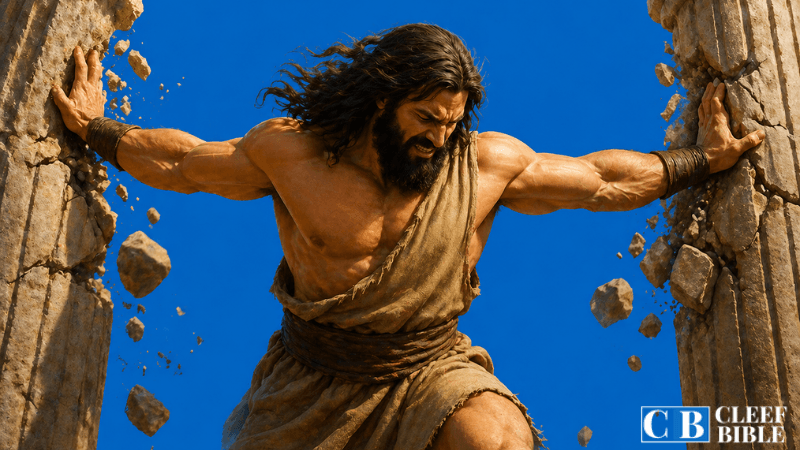
The Bible presents Samson with a prodigious strength. It is not explained by training or genetics, but by the action of the Spirit of God upon him.
Their strength had a clear purpose: to confront the Philistines And to remind Israel that God was still at work even in the midst of their oppression. It wasn't a force to show off, it was a force to serve.
Applied to your life, any visible gift, whether intellectual, physical, or emotional, follows the same pattern. It's not meant to inflate the ego, but to participate in God's work in your environment, be it your small group, your family, or your local church in the world.
Samson's hair and the Nazirite vow
Samson's famous hair was not a magic amulet. It represented his Nazarite vow, a special consecration to God that included visible signs.
- Not cutting one's hair, as a sign of a secluded life.
- Giving up certain pleasures and social customs.
- Remember each day that your identity was linked to God's calling.
That's why, when she loses her hair, she doesn't just lose a style. She symbolically breaks her pact, and what was already happening in her heart becomes evident.
Samson's hair in the Bible is an uncomfortable reminder The external and the internal must be in dialogue. The appearance of consecration is useless if the heart bargains with sin.
The human weaknesses of a strong man
Despite his consecration as Nazarite, Samson struggles with very human weaknesses.
- Impulsiveness in the face of anger and frustration.
- Disordered emotional relationships, where the figure of Dalila.
- Difficulty in submitting their emotions to God's will.
This combination of extraordinary gifts and immature character is what makes his story so relevant today. Many believers today are well-versed in the Bible and serve in the church, but they remain governed by anxiety, resentment, or the need for approval.
If you want to delve deeper into how the Bible portrays this tension between divine calling and human weakness, you can review other key accounts in the biblical stories, which present the same struggle in different characters.
Looking at Samson honestly invites you to a direct question: how are you managing the gifts God gave you, from consecration or from the impulse of the moment?
Spiritual Lessons from Samson in the Bible for Daily Life
When you look at the life of Samson in the Bible, You are not facing a perfect hero, but a man who mixes faith, ego, partial obedience, and profound moments of regret.
Faith that trusts, but sometimes forgets to listen
Samson knows the power of God. He experiences situations where his strength clearly comes from the Lord. However, many of his decisions stem not from prayer, but from impulse.
That tension is very relevant today. You can believe in God, know the Bible stories, even teach others, and still make hasty decisions without consulting the Lord.
- Healthy faith seeks God's will before acting.
- Immature faith, remembers God only when everything goes wrong.
If you are cell leader As an educator, this difference can guide your conversations and lesson plans. You can draw on introductory resources about the The Bible and its message to teach that biblical faith includes concrete obedience.
Obedience and inner strength
Samson's outward strength is impressive, but the story underscores something deeper. True strength lies in a heart that obeys.
Many of Samson's falls are related to a lack of self-control. His emotions take precedence over his calling. Herein lies a direct lesson.
- Obedience builds an internal strength that is unseen, but sustains in times of crisis.
- Repeated disobedience weakens character, even when the gift remains visible.
The consequences of ego and the need to depend on God
Samson's ego creeps in at several points. He enjoys the feeling of victory, becomes overconfident, exposes himself too much, and ends up trapped.
The ego does the same thing today. It convinces you that you can handle sin, complicated relationships, or temptation your way.
The story of Samson shows a clear pattern that you can use as a spiritual mirror.
- Exaggerated self-confidence forgets the real source of strength.
- Relaxation in consecration, limits and convictions are neglected.
- Falling and losing, experiencing shame and real consequences.
- A sincere cry, acknowledging the need for God.
Discover How the Bible Can Transform Your Life
- Bible Study – explore the teachings of the Bible and find answers to life’s challenges.
- Fundamental Beliefs – delves into the principles that have guided millions through the centuries.
- Spiritual Growth – Strengthen your faith with studies designed to bring you closer to God.

Discover How the Bible Can Transform Your Life
- Bible Study – explore the teachings of the Bible and find answers to life’s challenges.
- Fundamental Beliefs – delves into the principles that have guided millions through the centuries.
- Spiritual Growth – Strengthen your faith with studies designed to bring you closer to God.
Hope lies in the last point. Even when Samson hits rock bottom, his final prayer shows dependence and recognition that the strength was never his own.
If today you feel closer to falling than to victory, his story invites you to take a concrete step: to return to daily dependence on God, in prayer, in the Word, in the Christian community. To nourish this search, you can explore resources on Christian prayer and to make dependence on God a habit, not just a reaction to crisis.
Practical applications of Samson in the Bible for educators and cell group leaders
If you are a parent, educator, or cell leader, the story of Samson in the Bible It can become a very concrete tool for building character, faith, and discernment in today's world.
How to work on the story of Samson in small groups
With young people or adults, I recommend using a simple scheme that combines Bible reading, reflection, and personal application.
- Guided reading, divides Samson's life into key scenes, called, conflicts with the Philistines, relationship with Dalila, fall and final prayer.
- Open questions, Where do you see bravery? Where do you see immaturity? What would you have done in their place?
- Connection to daily life, It invites us to identify current “philistines”, pressures, temptations, and empty models of success.
As support, you can combine this study with resources that help to see the unity of the Bible, for example, a basic reading on the Old Testament that places Samson within God's plan.
Apps for Christian parents and educators
With children and pre-teens, Samson attracts a lot of attention, but the focus should not be on physical strength.
- Underline the word Nazarite and talks about what it means to be “set apart” for God in his school reality.
- It addresses the issue of limits, places, people, and content that protect or harm its consecration.
- He encourages families to pray together, asking for strong character, not just "success" or "talent".
For parents who are new to the faith, it may be helpful to supplement with introductory materials such as a general explanation of meaning of the Bible, so that they can see that Samson is part of a larger message.
To motivate personal and spiritual growth
For young people and adults, the story of Samson becomes a map of inner growth.
- Recognize the gift, Each participant identifies something they are strong at: abilities, resources, influence.
- Naming the weakness, emotions or habits that tend to sabotage that strength, impulsiveness, pride, discouragement.
- Defining a practical “vote”, Small, concrete commitments for this month, in the use of time, social networks, relationships, that express consecration to God.
- Return to prayer, Just as Samson cries out at the end, we must teach people to turn to God on a daily basis, not just in emergencies.
In a tired and fast-paced world, working with Samson as a story of fall and restoration can open up deep conversations about guilt, shame, and new opportunity in Christ.
If you are leading a group or a family, a good closing question might be, In what area of your life today do you need to stop acting like Samson in his pride and start reacting like Samson in his final prayer?
Samson in the Bible as a model of personal and spiritual growth
See Samson in the Bible As a role model of overcoming adversity, it does not mean copying his mistakes, but learning from the mix of light and shadow that marked his life.
His story is not a manual for perfect spiritual success. It is the tale of someone who knew God's calling, neglected it many times, and yet still found a way back.
Samson's virtues that inspire growth
In the midst of his failings, Samson displays traits that can guide your own quest for spiritual growth.
- Courage in the face of the enemy, he does not remain paralyzed by the Philistines, act and take risks.
- Awareness that their strength comes from God, He acknowledges that it is not his own merit, but a gift he has received.
- Ability to cry out again, When he hits rock bottom, he doesn't dwell on pride, he turns to God.
If you are in a process of inner growth, you can use these virtues as a small “spiritual thermometer,” for example, honestly checking how courageous you are in facing sin, how much you remember the true source of your strength, and how often you return to prayer.
To delve deeper into the biblical logic of the call and the human response, it may be helpful to review basic content on the message of the gospel, which show how God takes the initiative even in the midst of weakness.
Samson's mistakes as a mirror for your life
Samson's mistakes can become a map for those seeking to overcome harmful patterns.
- To confuse a gift with a license, as if having "strength" were permission to ignore limits.
- Letting emotions rule, anger, desire, pride, without submitting them to God.
- Playing with consecration, getting closer and closer to the edge of sin, thinking that nothing will happen.
A practical way to work on this part is to use a simple self-review scheme.
- Identify an area where you feel strong, for example, teaching, leadership, service, relationships.
- Notice what temptations appear right around that stronghold: the search for recognition, control, comfort.
- Define a clear boundary that you are not willing to cross, a kind of "Nazarene vow" applied to your reality.
Samson, the fall and the new beginning
The spiritual overcoming we see in Samson does not consist of "highlighting" his feats, but in looking at his final reaction when he had already lost almost everything.
Therein lies something crucial for any sincere seeker in the world today. True victory is not public image, but the posture of a heart that surrenders and acknowledges, "If I rise again, it will be by your grace, not by my own ability.".
If you are accompanying others on this journey, as a father, mother, or cell leader, The story of Samson reminds you that Christian overcoming involves three repeated movements: recognizing weakness, returning to God in prayer, and walking in concrete obedience, even when the consequences of the past are still present.
To maintain that rhythm in your daily life, it can help to establish fixed times for dialogue with God, inspired by resources such as those that explain the most famous prayer in the Bible, and let the story of Samson take you, again and again, from self-confidence to humble dependence.
Ask yourself a question, In what specific area of your life do you feel that God is inviting you to stop “playing” with your consecration and start a new beginning, as Samson did in his final prayer?
Conclusion about Samson in the Bible and a call to action for your life
Looking at the life of Samson in the Bible, A clear and very human picture emerges. A man with a genuine calling, impressive strength, and a complex background, who alternates between fidelity and self-reliance, between consecration and a dangerous game with sin.
We saw his historical context, a people without a king and pressured by the Philistines. We understood that his physical strength was a spiritual gift, linked to his identity as Nazarite. We also recognized his weaknesses, impulsiveness, ego, disordered relationships, and how that affects not only his life, but the entire community he was supposed to lead.
More than a comic book hero, Samson is a mirror. He reminds you that you can have a calling from God, visible gifts, and Christian experience, and still need a daily conversion of heart.
The great lesson is not in his death, but in his last prayer. In his moment of greatest shame, blind and humiliated, he acknowledges that strength was never his own. His story ultimately points toward grace, not spectacle.
How to bring the story of Samson into your daily life in the world
If you are a Bible student, cell group leader, parent, or spiritual seeker, you can use three concrete movements inspired by Samson.
- Recognize your strength, Thank God for the gifts and opportunities you have today.
- Name your weakness, admit before the Lord the areas where you tend to repeat Samson's mistakes.
- Return to dependency, to make prayer a daily rhythm, not just an emergency measure. To nurture this path, you can explore resources such as the explanation of the Christian prayer.
If you lead a small group or a family, I encourage you to use this story as a series of conversations. Read together, ask honest questions, relate Samson's "Philistines" to the pressures they face in the world today, and end each meeting praying for a stronger character than any visible gift.
Personal call, Don't let Samson be just a Sunday school memory. Ask yourself boldly, What specific decision will I make this week to live my consecration more seriously than yesterday?
I'd love to hear from you. What part of Samson's story impacts you more: his great feats or his ability to return to God in the midst of disaster? And if you'd like to delve deeper into other biblical characters and themes, you can take the next step by visiting [website address]. CleefBible's Bible blog and put together your own reading plan for this year.